CONVOCATION BY AMATEURS
Broodthaers Society of America
520 West 143rd Street
New York, NY 10031
Tuesdays, Fridays, and Sundays, 1:00–6:00pm
and by appointment
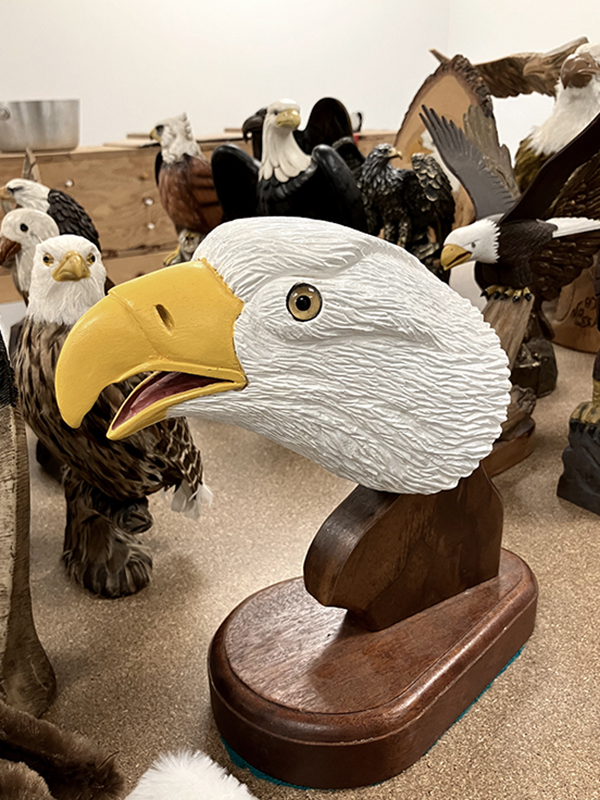
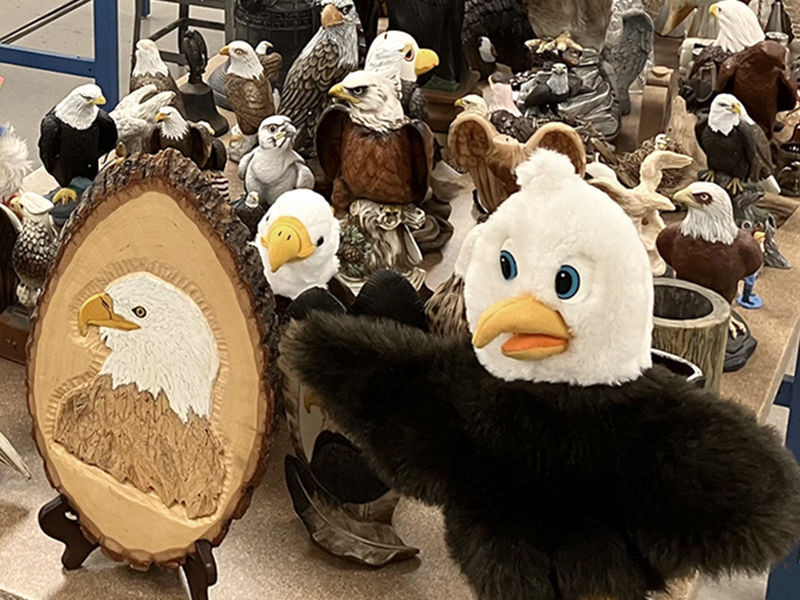
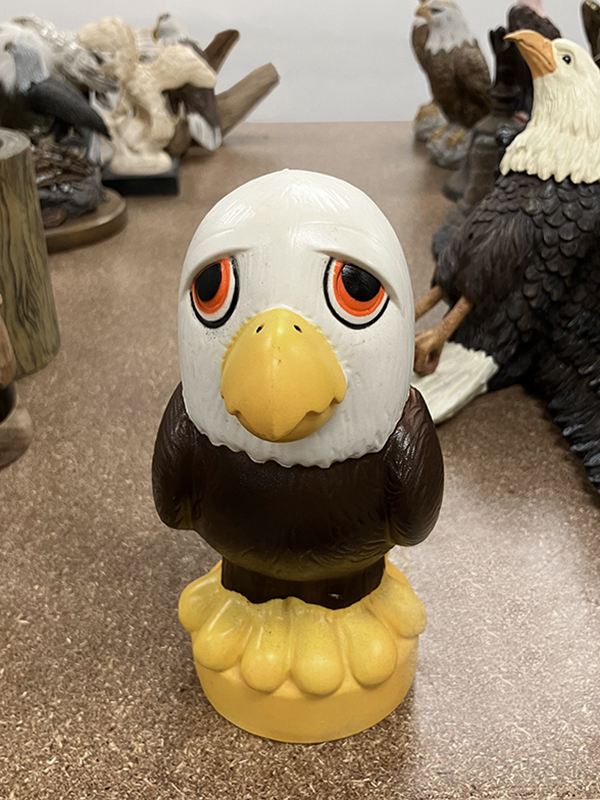
The Broodthaers Society of America is pleased to present CONVOCATION BY AMATEURS, an exhibition featuring a singular body of 100+ eagle figures culled from the noble dregs of everyday life: flea markets, thrift stores, transfer stations, and the internet. Each of the eagles is handmade, some show signs of having had commercial aspirations, and all are exemplary (for better and worse) of self-taught creative production. The sundry portrait busts, statuettes, soft sculptures, and figurines are made of wood, brass, stone, bronze, cast iron, wax, resin, ceramic, plastic, animal horn, eggshell, feathers, textiles, fake fur, and glass. In case you didn't know, "convocation" is the proper term for a gathering of eagles, just like a "rafter" of turkeys or a "school" of fish.
This exhibition is inspired by the work of three extremely different people: Marcel Broodthaers, Geoffrey Hinton, and Jim Day. In 1965, barely a year into his career a a visual artist, Marcel Broodthaers titled a small notebook "L'Art et l'Amateur" and scrawled some thoughts on the topic therein. The idea never developed into an explicit artwork but its inherent tensions run throughout Broodthaers' work, like an orange thread in a Harris tweed. In 1992, Galerie Ronny Van de Velde made a facsimile of the notebook as part of a show with another great amateur, James Ensor, and transcribed the notebook into legible French. CONVOCATION BY AMATEURS will present the first ever translation of Art and the Amateur in English.
Geoffrey Hinton's name may be familiar from public concerns regarding AI, because he was one of the first scientists to write a self-learning computer program. In the landmark essay "Learning representations by back-propagating errors," which Hinton coauthored with David E. Rummelhart and Ronald E. Williams, they described a new learning procedure called back propagation in which a neural network repeatedly adjusts (goes back and changes) its network connections. It does so based on its own evolving knowledge of the difference between its current output and the desired one. Hinton, known colloquially as "the Godfather of AI," is now one of the leading voices regarding AI's inherent dangers.
What does Geoffrey Hinton or back propagation have to do with this show? Well, 100+ eagles need to be organized in some fashion, and every curator knows the feeling of moving (and removing) a selection of artworks around the room until they arrive at what they think is the best arrangement. This is a human version of back propagation, the root and process of AI. We will be enacting it throughout the run of CONVOCATION BY AMATEURS, one day organizing the eagles by material or size, and the next day reorganizing them by attitude or skill.
Which brings us to Jim Day, a self-taught artist and world-champion taxidermist who lives and works in Florence, Indiana. Day's speciality is making lifelike recreations of bald eagles, an endeavor that at first glance should not be possible. Taxidermy by definition requires the skin of its subject (from the Greek taxis 'arrangement' and derma 'skin'), but possessing the body parts of bald eagles is severely restricted in the United States. Day gets around federal law by constructing his artworks out of the body parts of other birds. His ingenious, chimerical approach to making eagle sculptures by hand is the philosophical basis for this show.
From Day's extraordinary example of material substitution and craftsmanship, CONVOCATION BY AMATEURS expands to consider the United States as a necessarily unstable construct, one that is continually evaluated and back propagated by the people who make it up.
Now go vote.